




Everyone's an Imposter Now

Fellas, is it sus if your homie does this when y'all alone? Drawn by me in Procreate. 📷
I - Introducing the Problem & its Symptoms
I had quite the artist’s weekend recently. 4 hours of dance training on Saturday night, then 3 hours of painting with friends and drinks on Sunday.
There isn’t much point trying to express what I did in words. But I’ve interspersed some pictures throughout this post.
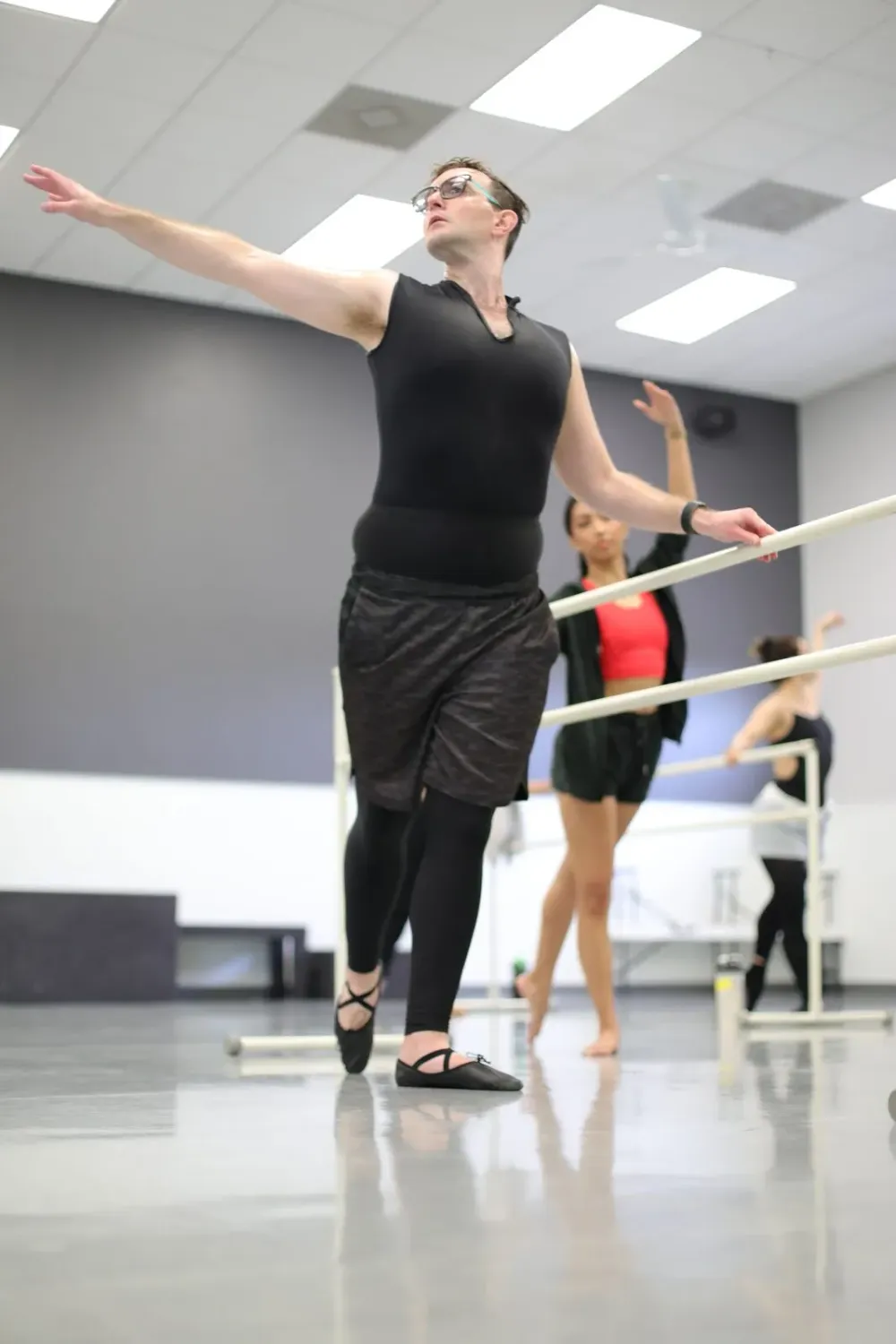
Me at the barre. Photo by Ricardo Romero through the Central Florida Choreographers’ Collaborative. 📷
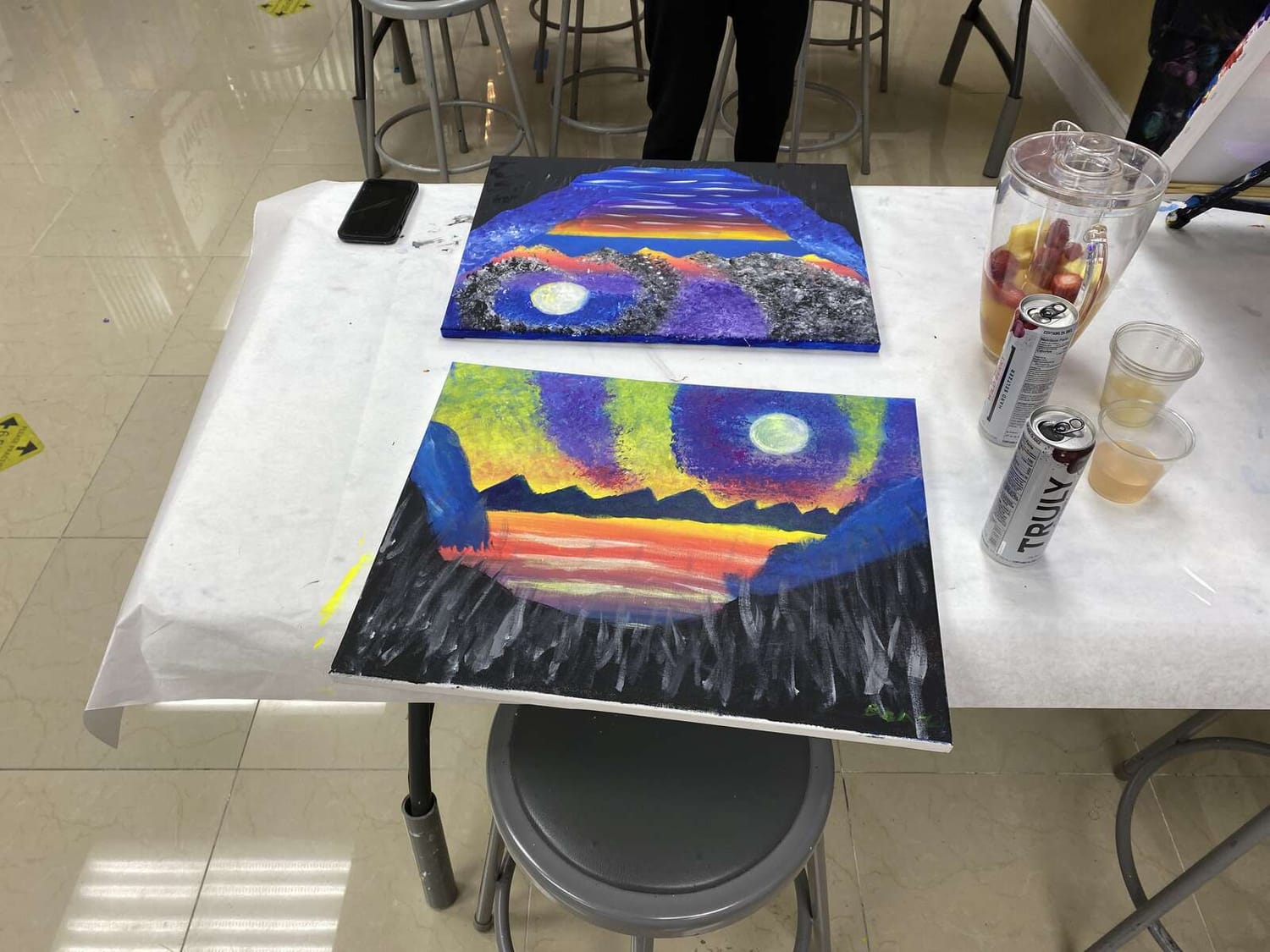
Picture by me of a painting by me. 📷
I have nothing but compliments for the experiences and the hosts that made them happen.
This isn’t an article about the experiences though. See, what’s caught my attention is an unexpected common theme:
Every expert I met over the weekend has Imposter’s Syndrome.
And ironically, the higher their skill level, the more they feel like frauds.
An Ironic Connection
I know choreographers currently performing at Universal Studios who believe they’re failures. Dancers I admire think they’ll never be admirable. Painters who lead painting classes, Bob Ross style, hate the pieces people literally pay for the right to watch them paint.
How absurd is it that we hate our creations that people are paying to imitate? Yet, how much easier is it to hate your creation when people are watching?
Etymology & Genealogy
The term “Imposter Syndrome” is brand new in English, and probably every other language too. First use was in a 1978 academic psychology paper by Clance and Imes. They recognized the problem was “particularly prevalent and intense” amongst their sample of exclusively high-achieving women.
I first heard the term in 2014 during a PhD student mentoring luncheon, when our speaker, a recent PhD graduate from my program, confided to the room that their Imposter’s Syndrome made them afraid to submit papers to journals.
Counselors didn’t have a questionnaire to measure Imposter’s Syndrome until 1985. Today, there are four different questionnaires psychologists have devised to gauge Imposter’s Syndrome.
Like all psychological questionnaires and personality inventories, the methods are ad-hoc, the measured concepts are poorly defined, and hence the data quality rarely inspires confidence.
The “scientific scales” are basically educated guesses by experienced professionals. Which is better than guesses from anyone else, but far below the “100% empirical and objective” bar that the Enlightenment and Logical Positivists set for the sciences.
Even though the term to describe the problem is brand new, and the “scientific scales” are jury-rigged, everybody on this accursed Earth seems to suffer from Imposter’s Syndrome now.
It feels like a universal experience that has plagued humanity since time immemorial, not since 1978.
Why?

A friendly imposter Amoogus I drew in Procreate, from the hit video game Among Us. 📷
II - Making Sense of the Problem with Scholastic Philosophy
Looking at Evaluation & Correcting Misconceptions
I think this new term, Imposter’s Syndrome, is pointing us towards a problem that is indeed timeless; a problem in how we evaluate our work and the work of others.
Evaluation begins before we’re consciously aware that we’re evaluating anything, and that’s a big problem if our evaluations usually involve self-flagellation.
When we talk about “evaluation” we usually imagine it as a conscious intellectual activity, and that’s not wrong. “Performance evaluations”, “classroom evaluations”, “employee evaluations”; these are all documents produced by a lot of conscious judgement. Some people make careers out of consciously evaluating others.
So it isn’t wrong to say evaluation often involves conscious effort. But we’ll miss a lot of the evaluative process if we ignore what the rest of us is doing. And we’ll probably pass over the root problem of Imposter’s Syndrome, too.
The 3 Stages of Evaluation
Let me introduce some Scholastic philosophy here. Most Scholastics, including St. Aquinas, John Poinsot, Jacques Maritain, and Yves Simon, recognize 3 stages involved in every evaluation. Getting familiar with these stages will help us grab the root of the problem.
1st stage: Apprehension. All the ways we immediately experience some object “in the moment”. It always starts with bodily sensations, but also involves some powers of the will and intellect. Nevertheless, apprehension is mostly unconscious and habitual. We aren’t micromanaging our every action during everyday apprehension.
2nd stage: Judgement. All the ways we mentally manipulate the object, which include both body and intellect. The bodily powers at work here are the memory, imagination, and cogitative (that’s the Scholastic term. Now this is commonly known as the executive functions). These are internal senses; powers that depend on the brain, in the same way vision depends on the eyes.
But the intellect and will are working concurrently, even though they aren’t bodily aspects of the human soul. The intellect is creating concepts. The will is evaluating the concepts and the memories. And all these different parts can accept input from each other while engaged in Judgement.
3rd stage: Reasoning. Using what we know to learn what we don’t know. Inductive and deductive reasoning. Modeling in all its forms: physical, graphical, conceptual and mathematical.
Reasoning primarily involves concepts, so it’s primarily the intellect at work here. But “there is no thought without imagination”, so the imagination is working here too (see Aquinas’ Summa Theologica Part I, Question 84, Article 7 for his explanation of this oft-repeated Scholastic idea). And the will is standing by to evaluate. So the intellect can receive feedback about its ideas from both the sensing body and the will.
Surprise! Evaluation Uses Every Faculty
Now here’s a surprising fact: none of these stages require conscious self-awareness or conscious effort.
It’s possible to pass judgement or even reason without being hyper-reflective of what you’re doing or thinking. Stay in school long enough and you’ll find yourself working through a problem in the shower, unaware you’re doing work until you found the answer (see r/ShowerThoughts for some examples that are cringe but prove this point).
Evaluation is more complex than it gets credit for. And the human soul is more powerful than we give it credit for. We don’t have to micromanage our external senses, our imagination, our intellect, or even our will for them to operate well. With proper training, each power works fine outside the spotlight of our conscious critical attention.
Evaluation requires all our powers, from our body through our imagination and up to our will. We use more than just our intellect to learn. We need our senses to apprehend. We need imagination to orient our concepts and make them work for us. And the will can step in and give some determinate input whenever needed.

A friend’s version of our painting. 📷
III - Applying the 3 Stages to Life
Being a Dance Critic
Let’s make all this abstract philosophy more practical. I’m a dancer, so let me give a dancer example to keep our thoughts grounded in reality. But the line of thought I’m about to tread could be applied to any kind of artist, like a painter. Or any intellectual, like a physicist or philosopher.
If you’re getting a degree in dance, you’re going to attend a lot of dance concerts and turn in written reviews of the shows. Part of being a professional dancer is being a professional dancer evaluator, a professional “dance critic.”
And all you’re really doing is training your apprehension to be as keen as possible. Dancers see things others don’t because they train what others don’t.
Now when you review a ballet piece, your evaluation doesn’t start after the show, once you’re back home at your desk, recalling memories of what happened earlier. Your evaluation starts as soon as you take your seat at the venue. If you don’t have a notepad to record your thoughts in real time, you’re already failing to do a proper evaluation.
The readers want your evaluations fresh from the moment of apprehension, not stale half-memories from a few nights afterward. Not even the best dancers remember any choreography 2 days after watching it once. You gotta capture the impressions at apprehension.
True, having time to ruminate can provide some new insights. It always takes a few rough drafts to turn your evaluation into a document someone will enjoy reading. And granted, you might think up some good reasons to reappraise your impressions in the moment.
But my point is, evaluation is more than just this time afterward when you’re consciously analyzing and armchair-philosophizing. You’ve been evaluating since you stepped in the venue.
A good dancer is especially attentive to others’ dance skills, whether they’re in the audience or learning someone else’s choreography as a cast dancer. Moreover, they’re especially attentive without committing much of their conscious energy.
They are so habituated into the discipline that keen apprehension is like a reflex. They already know the moves and their names, the muscles that should be activated, the history of the style, the dances the choreographer took inspiration from. All of this has become part of their routine life, so it comes to them as rapidly as the sensations themselves, without conscious effort or self-awareness.
It has become habit. And ideas can become part of the habit too.
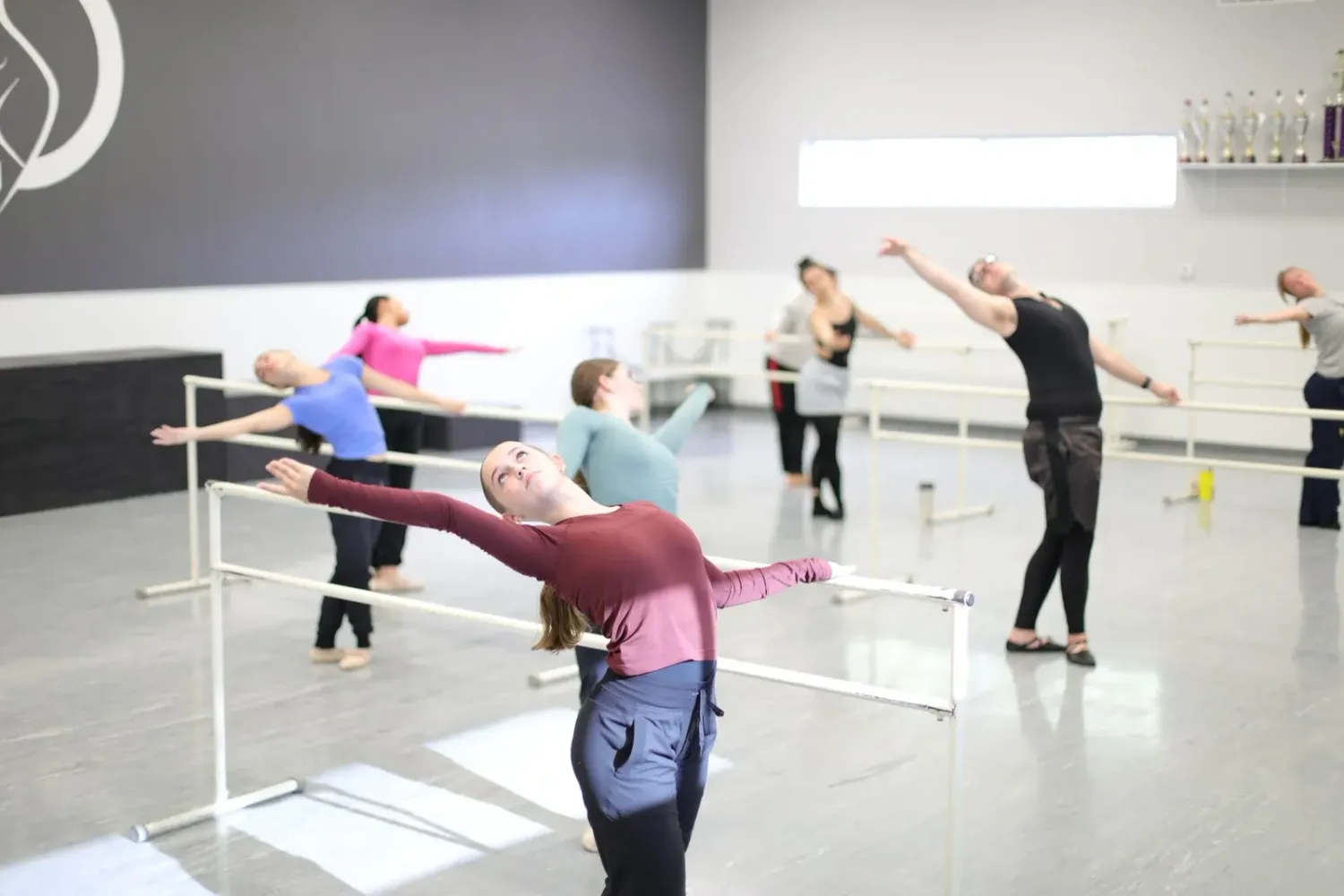
Practicing port de bras with my colleagues. Photo by Ricardo Romero through the Central Florida Choreographers’ Collaborative. 📷
Now the point of being in any discipline, or learning any skill, is to be good at that skill. A dancer dances with the intent to be a good dancer. So we always bring with us a standard of what’s “good” and “bad”, and judge what we apprehend according to that standard.
In the arts, that standard may be expressed as “beautiful” or “ugly”, but the connotation is the same. “Good,” “true,” and “beautiful” are always the things you want. “Bad,” “wrong,” and “ugly” are always the things you want to avoid.
Notice too that our dancer already has a foot in the stage of “judgement” by now. A dancer in the audience judges the dance they see as soon as their nervous system processes the stimuli. The stages of apprehension and judgement can occur near-simultaneously, although the apprehension does need to happen first.
Some of that judgement is conscious. But they are so habituated in dance that some of their judgement is unconscious.
Again, our intellect can engage without any self-awareness, self-scrutiny, self-reflection, or whatever you want to call it. Just because a process is driven by the intellect doesn’t mean it’s a process we’re consciously micro-managing.
I think that’s enough to drive home a simple point:
Evaluation starts long before self-awareness.
A negative evaluation can begin causing pain long before we’re self-aware enough to wonder where that pain is coming from. Long before that anxiety from Imposter's Syndrome sets in.
So if our evaluations make us hate ourselves, then it won’t be enough to simply realize how much we think about our shortcomings, as if it’s an argument to refute. Because the intellect isn’t necessarily the problem here.
The hatred may start at apprehension and our intellect simply accepts the evaluation we’ve already made. The problem is upstream from the intellect, in our habits of apprehension.
In the case of Imposter’s Syndrome, the problem can be a bad habit of apprehension. And bad habits only change due to good habits, not a single argument.
A Closing Thought
I’m not trying to explain away Imposter’s Syndrome with some guru-style life-hack. And I’m not trying to diagnose from afar. All I’ve intended to do so far is to raise awareness.
Not awareness about the problem, though. Everyone is already aware of Imposter Syndrome. But some common cultural assumptions can stop us from ever reaching the root of that fraudulent feeling.
Contrary to popular philosophy, our judgements aren’t pure products of conscious reason. So we can’t defeat Imposter Syndrome by arguing with ourselves, as if the cause is a clever argument we just haven’t found the solution to.
My point is to open opportunities for deeper self-reflection. We ignore so much of ourselves even in habitual, unconscious acts of judgement. But what if the root of our suffering is within our unconscious habits?
We can usually function without paying attention to our habits of thought. But maybe Imposter Syndrome is an indication that those habits require some attention.
☦️❤️🐍
You cannot think your way out of a bad habit, and you definitely can't edit your own blind spots.
Whether you are an author staring at a manuscript or a business owner staring at a blank sales page, isolated judgment breeds the 'fraud' feeling.
The cure for Imposter Syndrome isn't more self-talk; the cure is a trusted second set of eyes to validate the quality of your work. Stop evaluating in a vacuum. ⬇️
Comments are welcome. I read everything, but my charism is writing, not debate. So I respond selectively, only when conversation clearly serves truth and charity. If you don't receive a response, please don't take it personally. Time and energy are precious resources, and I steward them toward the essays themselves.
All comments go through moderation.
If you'd like to engage more substantively, consider writing your own response essay and contacting us through email or social media. I'd be honored to read it and potentially feature it as a guest essay.
☦️❤️🐍
~ Dr. Boaz
The Serpentine Byzantines

Joint Dr. Boaz, the Human

Sweet Potato, the Ball Python
We're a small team comprising a human and a snake.
Joint Dr. Boaz has a Joint PhD in Healthcare Ethics and Theology. He lives a 2nd life as a professional dancer. He's also a parish cantor, visual artist, and gaming streamer.
Sweet Potato is a male albino Ball Python. Born and raised in Florida, he's also traveled across the USA via road trips and even a flight! He's been blessed by a priest and once completed an entire Paschal Fast without eating a single meal.
Let's Connect!
All content © 2020-2026 The Orthodox Snake Writing Agency LLC